Let's face it, how many of you have really given a hoot about the immigrants in America? Feel free to pass judgments, but I rarely thought of them unless I was making some racy remark as a joke to a Latino friend of mine, all in good fun of course. This lecture, however, made me think a little bit deeper than what pun I could pull out next.
In her speech, Sonia Nazario talked a great deal about the lives she came into contact with while researching for her book/reliving the journey Enrique took in the book. And it was one of those moments where you just realize just how fortunate you are. She told a story of a mother who essentially abandoned her children to work in America and I was surprised when she admitted to thinking she was a terrible mother, pretty much reading my mind. But then she talked about how her children would cry with hunger pains and they would do things like roll over on their tummies to make them feel less hungry. Stories like these evoke such an emotional response that leave impacts on people like us at USC who are given every opportunity we need to succeed whereas there are others who are barely given the chance to survive. Heartfelt stories like these communicate a point --- effectively.
Sonia also mentioned facts, somewhat haphazardly thrown in the mix but they communicated a point as well. Her statistics, in my opinion, showed the magnitude of the journey as well as the massive number of people who were undergoing the same journey Enrique had as well as Sonia herself. I remember her throwing out numbers that shocked me, whether it was the number of attempts one person made, the number of people atop one train, the number of illegal immigrants that managed to make it, etc. Factual evidence like that really gave the retelling of one story a broader perspective: what one person was going through, thousands upon thousands were too.
Overall, I enjoyed her speech. It was a serious wakeup call. The next time I eat a meal or take the train somewhere, I will undoubtedly be thinking of the hardship some poor underprivileged kids out there underwent just to find their mother who had left out of desperation to feed them. I couldn't imagine anything like that. I get homesick living a few hours away for a few months, let alone years alone! Sonia Nazario undoubtedly made the emotional aspect of immigration real and lasting within my, and I'm sure the rest of the audience's minds.
Thursday, October 28, 2010

Monday, October 18, 2010
Journalists For Justice
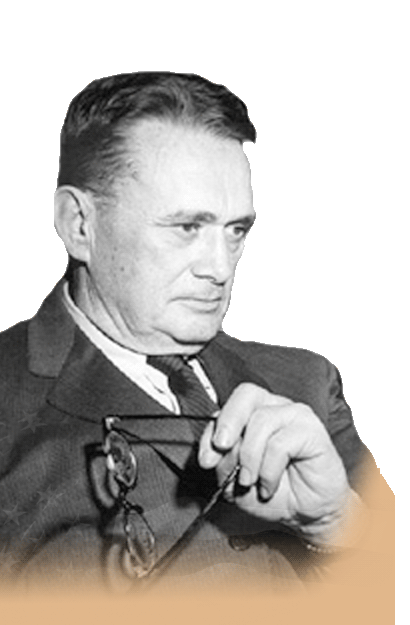
Though the broad scope of white activists in the civil rights movement is one that should have more emphasis in the school curriculum, one topic I would find extremely appropriate to include would be Ralph Emerson McGill.
This man was the editor and publisher of the Atlanta Constitution. What I respect most about this man an article states well, by saying "the voice of one newspaper editor [McGill] provoked a dialogue about race in the Deep South where segregation was the law and polite society did not discuss that intractable 'situation.'" He refused to remain silent about race during this time period and took it upon himself to stimulate a public discourse on race by highlighting social injustice and the failures of the system of segregation. In his columns, he called for whites to accept the inevitable changes being brought by the civil rights movement.
Though the idea of McGill being a white soldier with the power of his unyielding pen fighting for civil rights is what some history books might portray this man as, we cannot fall into the same trap over and over again. We cannot skew the perceptions of people in order to communicate a more righteous interpretation, as seen with Lincoln (him being not so much an advocate for civil rights as maintaining the union) and Martin Luther King, Jr. (sexist ideals). McGill did not initially call for the end to the concept of "separate but equal," in the South, but instead, he wrote in great detail about the wide disparities between conditions in white schools and black schools of the region. He knew that he would loose his audience completely if he had relentlessly talked about racism and segregation. Instead, he did more of an alternating pattern with one issue talking about more commonplace things then writing about race, etc. The KKK labeled him "public enemy number one" and he received death threats, burning crosses in his yard and put his life in danger for his beliefs.
Overall, his willingness to bring the issue of segregation to the public using publications, though not necessarily advocating integration makes this man a noteworthy one. Schools should know about him not only to give him credit, but also to reaffirm the overarching idea that the Civil Rights Movement was not exclusive to only African Americans and undermine the idea that all white Americans adopted racist ideals and fought against the cause.
Friday, October 15, 2010
What about us?
Michael Schwerner. Andrew Goodman. James Chaney. Rita Schwerner. Viola Gregg Liuzzo. Lillian Smith. Virginia Durr. Ralph McGill. Eugene Patterson. Buddy Davis.
Do any of these names sound familiar? Unsurprisingly no, I'm sure.
These are a few of the names of white Americans that fought in the civil rights movement in favor of African Americans, and more than half of these names lost their lives in this struggle. Now why is it that these people have been lost in history? They may have fought just as hard as Rosa Parks or Martin Luther King, yet they receive no recognition for their contributions. The idea of "leaders" taking it upon themselves to lead a cause and spur action and make changes that attributes to this lack of recognition. History is built upon the figures in the limelight, shirking aside all the "little people".
While many African Americans fought and were lost in the recesses of time, the White American supporters played a different, yet vital role to the movement. I'm pretty positive I paid a good amount of attention in high school (despite History not exactly being my favorite subject), and I was still left with the impression that well, white people hated blacks and never wanted to see them free. I was sure there must have been some anomalies out there, some white sympathizers, but overall I had been pretty positive that they must have been too afraid of the backlash to do much to support. A rather naive view, in hindsight.
In actuality, the white role in the civil rights movement was crucial. They were able to appeal far more to their people than African Americans. They had the innate ethos necessary to start tearing down some of the ingrained racist ideals of the majority. It is not fair to push aside their contributions when they risked so much to fight for what they believed to be moral and just, parallel to the African Americans.
Something to take away from this would be that it wasn't just the African Americans struggling for their rights. They had help from many races. I mean, I never knew Asians cared about the movement until Prof. Kelley assigned our reading on it. While the struggle was clearly a predominantly African American one, without help from all ends, who knows how it would have panned out?
Subscribe to:
Posts (Atom)