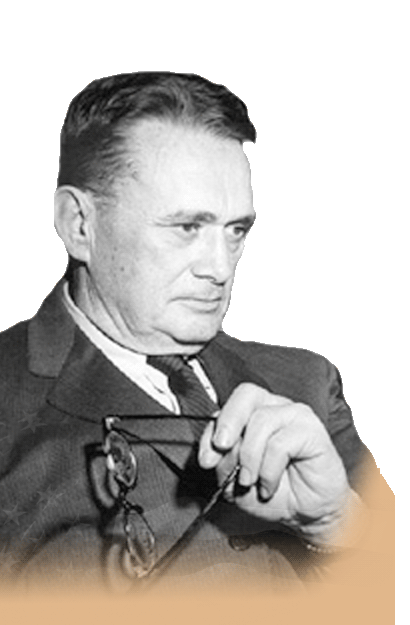
Though the broad scope of white activists in the civil rights movement is one that should have more emphasis in the school curriculum, one topic I would find extremely appropriate to include would be Ralph Emerson McGill.
This man was the editor and publisher of the Atlanta Constitution. What I respect most about this man an article states well, by saying "the voice of one newspaper editor [McGill] provoked a dialogue about race in the Deep South where segregation was the law and polite society did not discuss that intractable 'situation.'" He refused to remain silent about race during this time period and took it upon himself to stimulate a public discourse on race by highlighting social injustice and the failures of the system of segregation. In his columns, he called for whites to accept the inevitable changes being brought by the civil rights movement.
Though the idea of McGill being a white soldier with the power of his unyielding pen fighting for civil rights is what some history books might portray this man as, we cannot fall into the same trap over and over again. We cannot skew the perceptions of people in order to communicate a more righteous interpretation, as seen with Lincoln (him being not so much an advocate for civil rights as maintaining the union) and Martin Luther King, Jr. (sexist ideals). McGill did not initially call for the end to the concept of "separate but equal," in the South, but instead, he wrote in great detail about the wide disparities between conditions in white schools and black schools of the region. He knew that he would loose his audience completely if he had relentlessly talked about racism and segregation. Instead, he did more of an alternating pattern with one issue talking about more commonplace things then writing about race, etc. The KKK labeled him "public enemy number one" and he received death threats, burning crosses in his yard and put his life in danger for his beliefs.
Overall, his willingness to bring the issue of segregation to the public using publications, though not necessarily advocating integration makes this man a noteworthy one. Schools should know about him not only to give him credit, but also to reaffirm the overarching idea that the Civil Rights Movement was not exclusive to only African Americans and undermine the idea that all white Americans adopted racist ideals and fought against the cause.

I wanted to mention this in your last post: Were whites not included in the retelling of events of the Civil Rights Movement because there was no space in the short lessons textbooks taught which teachers, ignorant to the activism during the 1950s and 1960s, had no clue what to teach?
ReplyDeleteI agree with your argument that Whites that fought alongside Blacks during this time were definitely brave. It is already a scary situation to stand up to your government and community, but it is also scary to be viewed as traitor to your race.
Thinking of this inspired me to mention the new forms of activism. I wanted to bring up the topic of the past assignment because it relates to this topic. The activism people did during the civil rights movement, heavily contrasts from the activism people do now. I could not imagine my peers going and standing up to the government with a couple of their friends. What is unheard of and viewed as impossible today was just an act of bravery to the activist in the past.